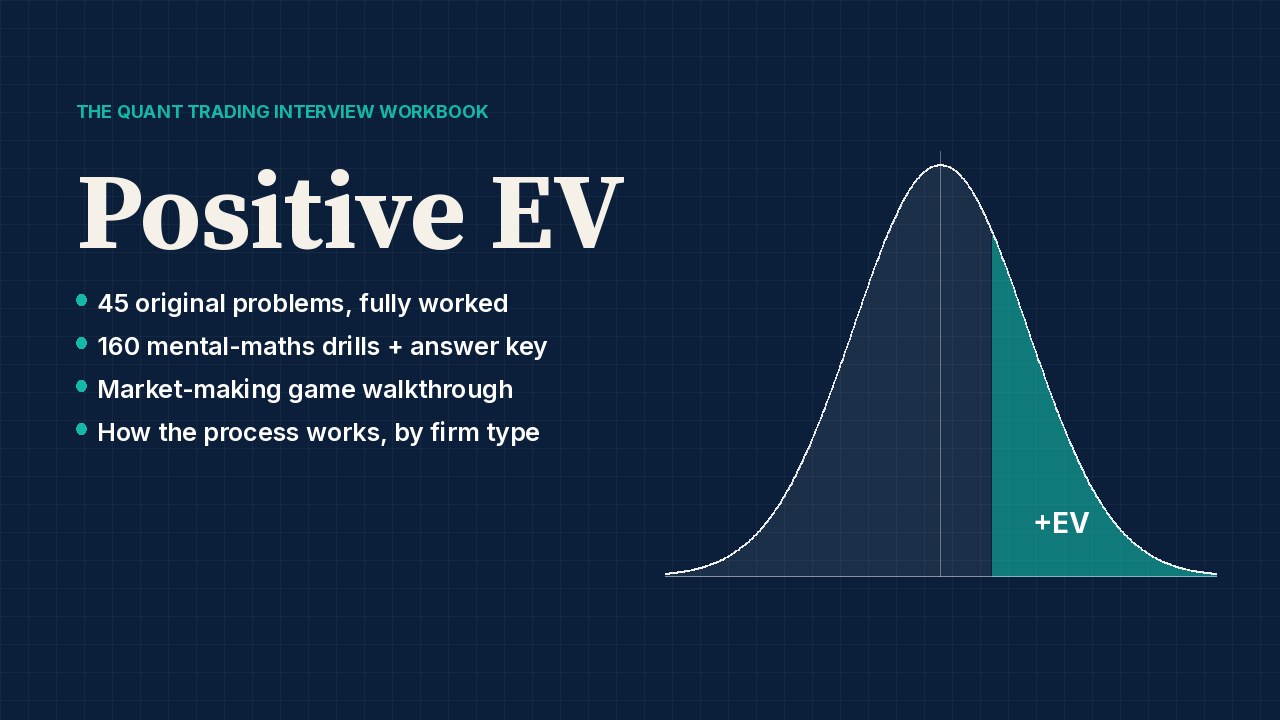
45 original interview problems with full worked solutions, 160 timed mental-maths drills, a market-making game played out round by round, and a plain guide to how the process works. A 50-page PDF built to read on your phone.
45 original problems in probability, expected value, brainteasers, market making and counting, in the style trading firms ask. Each one has a full worked solution and the interview tip that goes with it.
Every answer checked. Each one was verified by exact calculation and, where possible, computer simulation.
Mental maths, 80-in-8 style: the techniques worth automating, two timed 80-question drills, and answer keys.
A market-making game, round by round: fair values, quote widths, inventory skew, and why you can lose money while trading well.
How the process works at market makers, quant funds, investment banks and private equity, plus a two-week plan and a one-page formula sheet.
A look inside
Three free problems
Try them before you buy. Give each one five minutes, then open the solution.
Problem 3 · Probability ●●○
Pattern race
Alice and Bob watch the same sequence of fair coin flips. Alice wins if TTH appears before THT; Bob wins otherwise. What is Alice's probability of winning?
Show the worked solution
Use states. Heads at the start are useless to both players, so the states that matter are: start, T, TT and TH.
From TT, Alice has won: the next H completes TTH, and another T leaves you at TT. So P(Alice | TT) = 1.
From TH, a T completes Bob's THT; an H kills both patterns and returns you to start. So P(TH) = ½ · 0 + ½ · P(start).
From T: P(T) = ½ · P(TT) + ½ · P(TH) = ½ + ¼ · P(start). And P(start) = P(T), since an H at the start changes nothing.
p = ½ + ¼p ⇒ p = 2/3.
Alice wins with probability 2/3 (simulation over 100,000 races agrees). Once she gets TT she cannot lose, which is the source of her edge.
Answer 2/3
Problem 14 · Expected Value & Games ●●○
Paying to reroll
Same die game, but now you may reroll as many times as you like, and each reroll costs £1. What is your optimal strategy and the game's value?
Show the worked solution
Let V be the value before a roll. After seeing x you either stop with x or pay £1 to continue with V − 1. Try the rule "keep 4 or more":
Check consistency: continuing is worth V − 1 = 3. Keeping 4, 5 or 6 beats that, rerolling 1 or 2 beats keeping, and a 3 is an exact tie. "Keep 3 or more" gives V = 4 too. Any other threshold does worse (keep 5+ gives 3.5; keep 2+ gives 3.8).
Answer: worth £4. Keep anything 4 or above; a 3 is a coin-flip decision.
Answer £4; keep 4+, indifferent on a 3
Problem 33 · Markets & Making Prices ●○○
Make a market: two dice
"Make me a market on the sum of two dice I'm about to roll." Then: "Actually, I've already rolled them and I'm looking at one of them. Your market?"
Show the worked solution
Part 1: the fair value is 7 and the standard deviation is √(35/6) ≈ 2.4. Nobody has an information edge, so a tight market around 7 is fine, e.g. 6.5 at 7.5. Any trade at your price earns you 0.5 in expectation.
Part 2: now the interviewer knows one die, d. To them the fair value is d + 3.5, which ranges from 4.5 to 9.5. If you quote 6.5–7.5, they buy from you whenever d ≥ 5 and sell to you whenever d ≤ 2. You lose on every trade they choose to do.
Good answer: widen substantially (e.g. 5 at 9), quote smaller size, or ask about size limits, and say why: "you have information I don't, so I need to be paid for the adverse selection." If they then trade, update: a buy at 9 tells you d is probably 6.
Answer 7 (e.g. 6.5 at 7.5); widen sharply once they've seen a die
Get the full workbook
£7 = 9 USDC
50-page PDF · instant download · read on phone, tablet or print
Send 9 USDC on Base to 0xf4a93722fA90d57f4BCdfa3bd11245F06976dF7d Open in my wallet app
Paste the transaction hash below. This page checks the payment on-chain and unlocks your download straight away.
Who is it for? Students preparing for trading, quant, sales & trading or strats interviews, especially first rounds and online assessments.
Is this the official process for any firm? No. The process guide is general guidance based on commonly reported candidate experience. Formats change every year, so always check each firm's own instructions.
How was it made? It was written with AI assistance, and every numerical answer was checked by exact calculation and simulation. The problems are original. They use classic puzzle types, but they are not copied from any book.